
Bathroom & Toilet Lighting Guide for Singapore HDB and Condo Homes
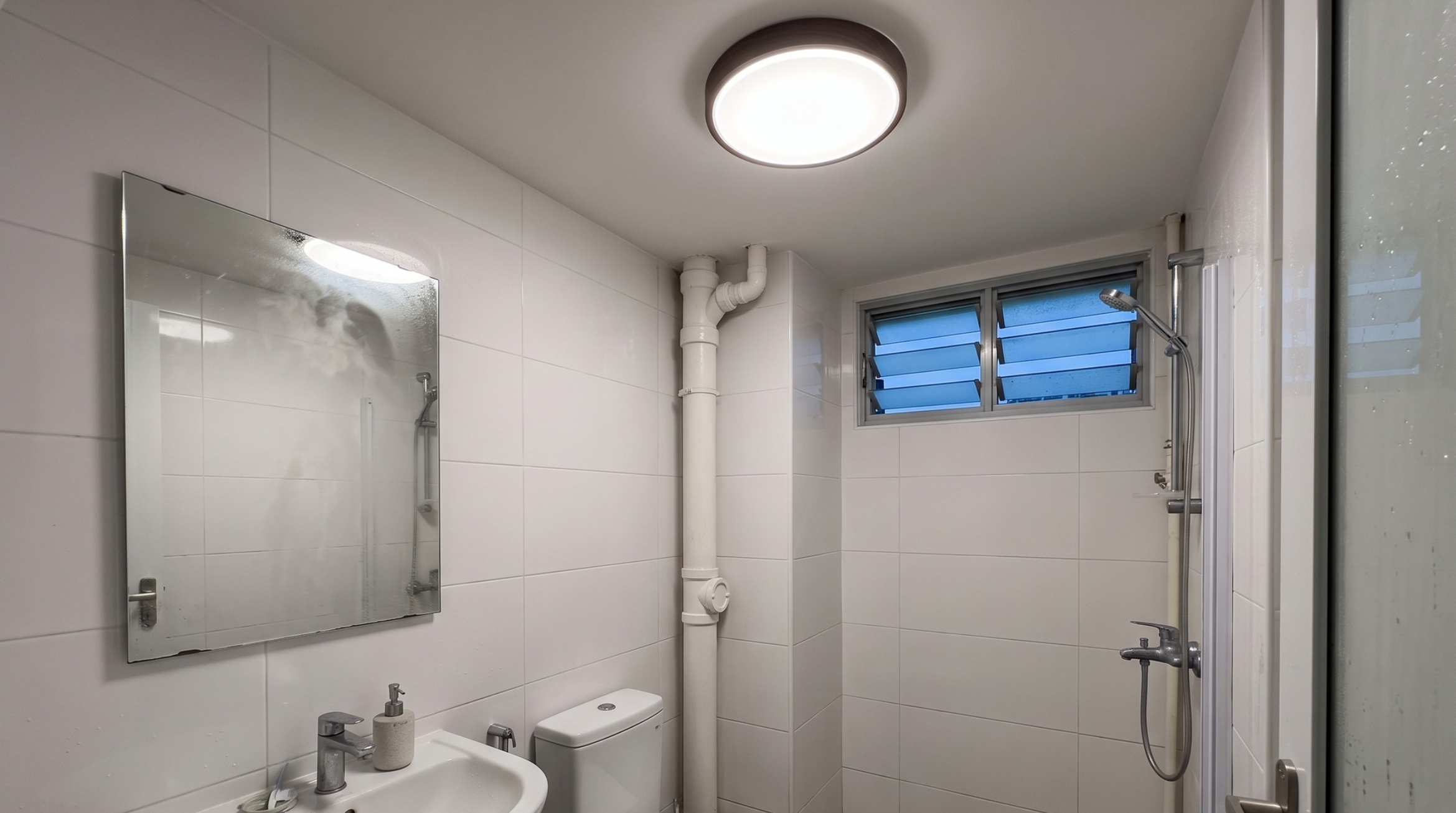
Most Singapore bathrooms have one light in the middle of the ceiling and nothing else. It works, more or less. But it’s also why you look washed out in your own mirror — light coming straight down casts shadows under your brow, nose and chin, which is exactly where you need to see clearly when shaving or doing makeup.
The other issue is the room itself. Bathrooms here deal with steam, splashing and humidity that already averages 82% before anyone turns on a hot shower. That’s harder on a light fitting than anywhere else in the house apart from outdoors.
Here’s how to get both parts right.
IP Ratings for Bathrooms and Wet Areas
Every light fitting carries an IP (Ingress Protection) rating under the IEC 60529 standard — first digit for dust, second for water. In bathrooms, the convention is to think about the room in zones, based on how close each spot is to water.
Worth knowing: under Singapore Standard SS 638, the Code of Practice for Electrical Installations, bathrooms and toilets are classified as wet areas. That’s the reason power points aren’t permitted inside them.
Matching the Rating to the Zone
Directly above or inside the shower — the wettest spot in the room. IP65 is the sensible standard here, and this is the one place where saving money on the rating is a bad idea.
Near the basin, shower door, or anywhere splashes and steam reach — IP44 is generally treated as the safe minimum.
The rest of the ceiling, away from water — a standard IP20 fitting is technically fine. Many people still go IP44 throughout, simply because Singapore bathrooms stay damp for hours after a shower.
Why Small HDB Toilets Need a Simpler Approach
Plenty of older HDB toilets have no partition at all between the shower and the rest of the room. Steam and spray reach every surface, so measuring distances from the shower head doesn’t tell you much.
In that situation, treat the whole ceiling as a wet area and use IP44 or higher throughout. It’s simpler than mixing ratings, and it removes the guesswork.
Brightness and Colour Temperature
Bathroom lighting has to be bright enough for close-up tasks without feeling like a clinic.
3000K to 4000K (warm to neutral white) works well for general bathroom lighting — clear enough to see properly, without a cold edge.
Cooler white, 5000K to 6000K, is often preferred at the mirror. Cooler light with good colour rendering shows skin tone more accurately, which matters for makeup and shaving. The Round LED Ceiling Light – Orion Cocoa is a 20W 6000K daylight fitting at 26cm across, sized for compact HDB toilets and small rooms.
Avoid warm 2700K as your only source. It looks cosy, but it makes close detail work harder than most people expect.
There’s a trade-off here worth being straight about. Cool white is better for grooming and worse for relaxing. If your bathroom doubles as somewhere you actually want to unwind, a warmer ceiling light with a cooler light at the mirror gives you both.
Layered Lighting: Ceiling Plus Mirror
This is the single change that makes the biggest difference, and it’s cheaper than most people assume.
A ceiling light or downlight handles general light across the room.
A mirror or vanity light sits at roughly eye level — either wall lights on both sides of the mirror, or an LED mirror with lighting built into the frame. Lighting your face from the front instead of from above removes the shadow problem entirely.
Where the wall points already exist, this usually doesn’t need major rewiring. If they don’t, it’s worth planning during a renovation rather than retrofitting later.
Lighting for Common HDB and Condo Toilet Layouts
Older HDB Flats with a Combined Wet and Dry Area
No shower screen means the whole room is a wet zone. An IP44-or-higher ceiling fitting plus a mirror light covers both safety and practicality. Compact round fittings work best here — ceiling space is usually tight.
Newer BTO Flats with Separated Zones
A shower screen gives you more options. A standard-rated downlight works over the dry basin and mirror area, while the zone above the shower still needs a properly rated fitting. If you’re putting in a false ceiling, this is the moment to decide on downlight positions.
Condo Master Ensuites
Usually larger, and often already fitted with a vanity counter. That makes a dedicated mirror light or an LED mirror a natural addition alongside the ceiling light. Aspire’s bathroom mirror range sits alongside the rest of the sanitaryware, so it can be matched to the basin and cabinet at the same time.
Planning a Bathroom Lighting Upgrade
If you’re renovating the whole bathroom, plan the lighting alongside the toilet bowl, basin and mirror rather than leaving it to the end. The mirror decision in particular changes everything downstream — an LED mirror means you may not need separate wall lights at all.
If the work goes beyond swapping a bulb, it’s worth having it done by a professional electrician.
Common Questions About Bathroom Lighting
Do I really need an IP-rated light in a small HDB toilet?
If the shower isn’t separated from the rest of the room, yes. Steam reaches the whole ceiling. IP44 as a minimum, IP65 if the fitting sits anywhere near the shower itself.
Why do I look washed out in my bathroom mirror?
Almost always a single overhead light. Light from directly above throws shadows down your face. Adding light at eye level beside the mirror fixes it.
Can I put a downlight above the shower?
Only if it’s rated for it — IP65 for that position. A standard indoor downlight above a shower is a genuine safety risk, not just a durability one.
Aspire Lightings is a lighting shop in Singapore stocking both lighting and sanitaryware at its Bendemeer Road showroom, so the fittings, mirrors and IP ratings can be sorted in one trip rather than three.
Contact
Aspire Lightings Pte Ltd
994 Bendemeer Road, #01-05 B-Central, Singapore 339943
Phone: +65 6909 0528 | WhatsApp: +65 8685 8188
Website: aspirelights.com
Contact us