
LED Spotlights Singapore: Types, Placement & How to Choose
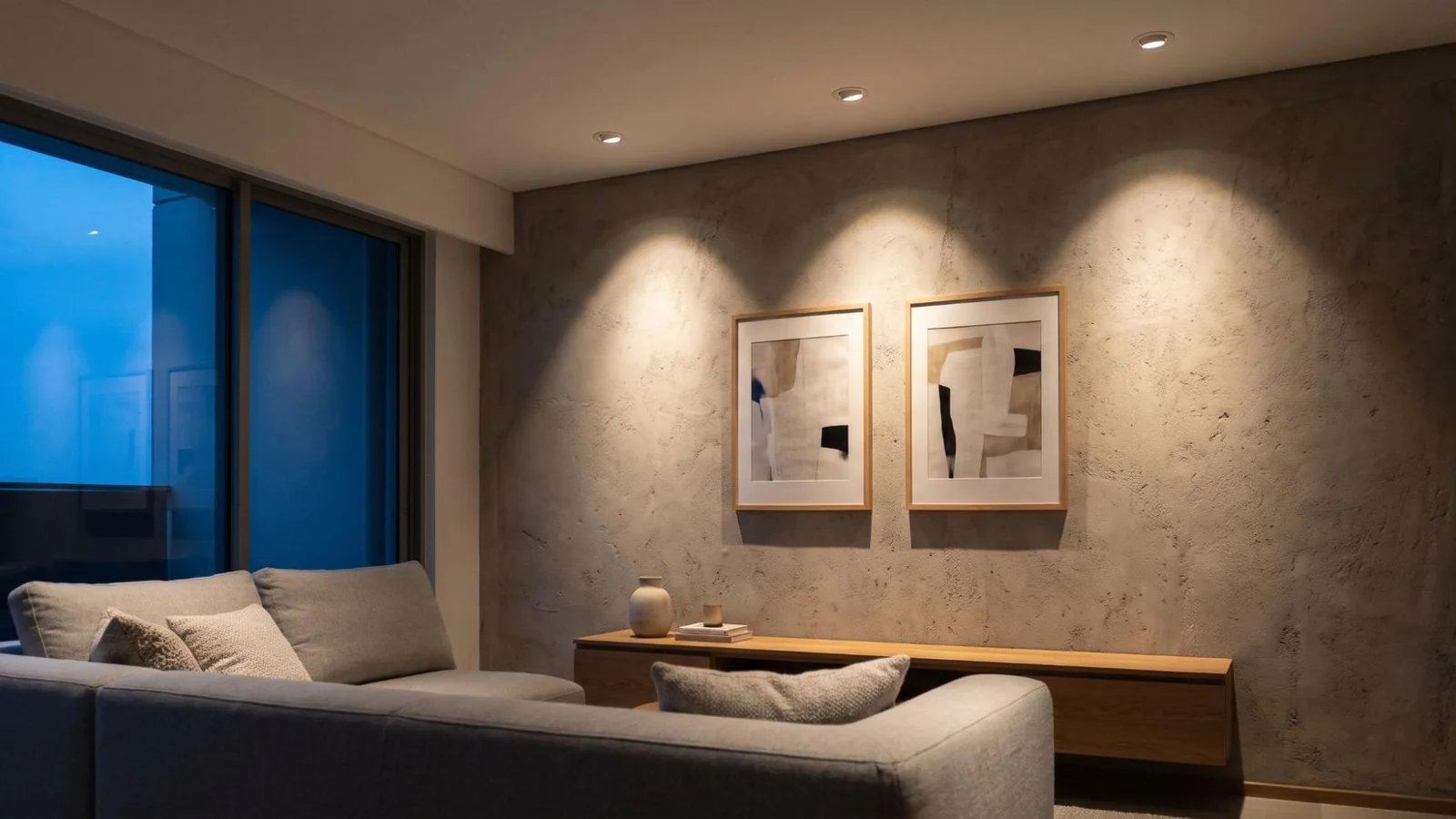
A ceiling light illuminates a room, while an LED spotlight directs light towards a specific area: a painting, a shelf, a kitchen counter, or a favourite reading corner.
In Singapore homes, spotlights are often arranged in neat rows across the ceiling without considering where the light is actually needed. The result is bright patches, dark corners, and unwanted glare.
Choosing the right beam angle is important, but positioning matters just as much. At Aspire Lightings, we cross-check furniture layouts, finished ceiling heights, and intended lighting effects before recommending LED spotlight positions.
A few well-placed spotlights can easily achieve more than a ceiling filled with poorly positioned lights.
What Makes a Spotlight Different From a Downlight
A downlight generally provides broader illumination across a room, while a spotlight concentrates light onto a particular area or feature. Our guide to the types of downlights covers the broader-beam options.
LED spotlights are available with replaceable GU10 bulbs or integrated LED light sources, including COB (Chip-on-Board) technology.
| Features | GU10 Spotlights | Integrated LED Spotlights |
|---|---|---|
| Light source | Replaceable GU10 bulb | Built-in LED chip or COB with integrated or external driver |
| Replacement | Tool-free bulb replacement | External driver, LED module, or entire fitting may require replacement |
| Colour & beam angle | Flexible; changed by swapping to a compatible GU10 bulb | Fixed optical spec; select models offer tri-tone or lens adjustments |
| Maintenance | Readily available standard bulbs; easy DIY swap | Requires replacing the external driver or complete fitting upon end-of-life |
The Three Ways to Mount a Spotlight
| Spotlight type | Ideal for | Key considerations |
|---|---|---|
| Recessed spotlights | Homes with false ceilings | Cut-out hole required. Verify the fitting height to ensure it fits the vertical depth between the false ceiling and concrete slab. |
| Surface-mounted spotlights | Homes without false ceilings | Check the fitting height, appearance and beam angle. |
| Track spotlights | Concrete or false ceilings. Living rooms, feature walls and spaces requiring flexible lighting arrangements. | Check track compatibility. Magnetic track system requires a driver. |
Recessed Spotlights
- Vinkel Round Tiltable Recessed Spotlight: Adjustable spotlight direction for illuminating feature walls, artwork and display cabinets. Available in a square version for sharper ceiling lines.
- 703 Anti-Glare GU10 Recessed Spotlight: Deep-recessed spotlight design that helps reduce direct glare. Available in round, square and twin configurations.
- Gypsum Trimless Recessed Spotlight: Plastered into the false ceiling for a clean, trimless spotlight appearance. Requires coordination before ceiling finishing.
Surface-Mounted Spotlights
Surface-mounted spotlights install directly onto the ceiling without a recessed cut-out, making them ideal for HDB flats without false ceilings while preserving ceiling height.
Cylinder designs like Astra and Rand provide focused downward lighting with a clean, minimalist appearance. Both use replaceable GU10 bulbs for easy maintenance.
For adjustable lighting, the LED Rotatable & Tiltable Ceiling Spotlight offers 360° rotation and 90° tilt, allowing you to direct light towards feature walls, artwork or specific areas.
Explore our surface mount downlight collection for round, square and double options.
Track Spotlights
Spotlight heads clip onto a rail and can be rotated, tilted and slid along it. This is the most flexible option, and the one to choose if you’ll want to re-aim the lights later or your furniture moves often.
The Tracklight White is a compact rotatable, tiltable GU10 head, and the Walnut adds a wood-grain finish for warmer interiors. If you want a cleaner rail with no clips, magnetic track takes it further. See our guide on how magnetic track lighting works.
Beam Angle: What You Need to Know
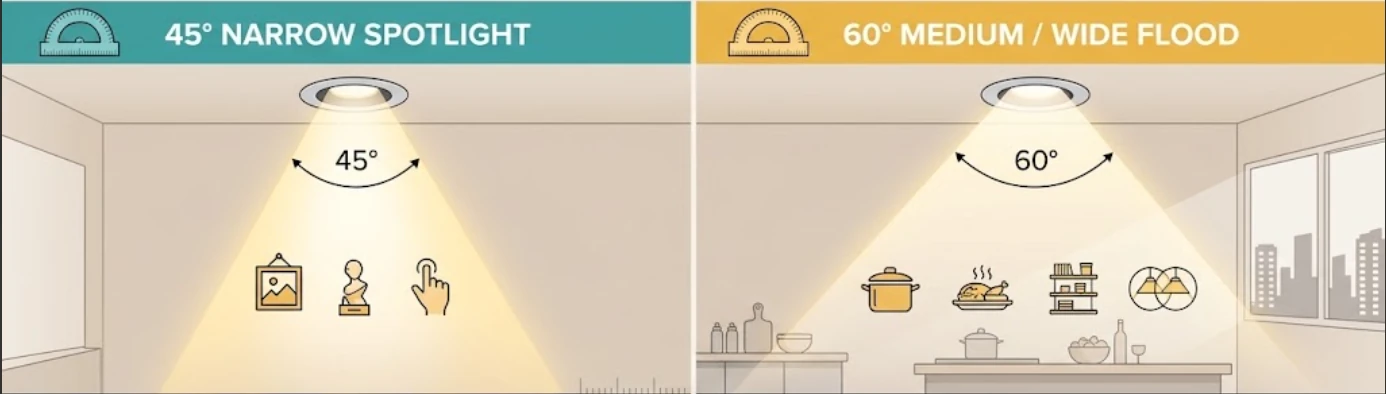
The beam angle tells you how wide the cone of light spreads. A narrow beam concentrates light onto a small area. A wide beam covers more ground but less intensely.
As a general guide, beams of 60° and wider suit general lighting, while narrower beams around 36° are used to pick out objects or smaller areas.
Two examples from Aspire Lightings:
- LED Spotlight Module – 36°: A 12W, 1200-lumen module suited for artwork, feature walls and focused task lighting.
- Sunshine 7W GU10 – 65°: A replaceable 770-lumen bulb offering broader coverage for kitchens, wardrobes and corridors.
Pro tip: Ceiling height, spotlight positioning and spacing also affect how evenly the light spreads.
Why Ceiling Height Changes the Result
The further the light source is from the surface, the wider the cone gets when it lands. A beam that looks tight from a low ceiling spreads noticeably at a higher one.
Standard HDB floor-to-ceiling heights run between 2.6 and 2.75 metres, and a false ceiling drops that further. That relatively short distance means even a 60° beam stays fairly contained in most HDB rooms, so if you want a sharp highlight on a painting, the 45° beam angle is the safer choice. In a landed home or condo with a higher ceiling, the same beams will spread wider.
Choosing Colour Temperature for Spotlights
The three common options are:
- 3000K Warm White: Creates a warmer, more relaxing atmosphere. Suitable for bedrooms, dining areas, living rooms and decorative feature lighting.
- 4000K Cool White: Provides a more neutral appearance. Suitable for kitchens, studies, wardrobes and everyday task lighting.
- 6500K Daylight: Produces a cooler, brighter-looking light colour, often preferred in utility and task-focused spaces.
Some GU10 bulbs, such as Aspire’s Liniq 6W 3-Tone GU10, allow selection between 3000K, 4000K and 6500K.
Colour temperature is only part of the decision. Colour rendering also matters, especially when illuminating artwork, timber finishes, fabrics and decorative materials.
Where LED Spotlights Work Best at Home
Feature Walls and Artwork
A tiltable recessed spotlight or a track head angled at the wall, with a 45° bulb in warm white. Aim it from slightly in front of the wall rather than directly above, so the light hits the surface instead of grazing straight down it.
Kitchen Counters and Islands
Track or recessed spotlights over the work surface, with 60° bulbs in cool white so the whole counter is lit evenly, not just a pool in the middle. For the decorative layer above an island, see our kitchen island pendant light guide.
Wardrobes and Shelving
Narrow fittings pointed into the shelves, so you can actually see what’s at the back.
Corridors
Surface or recessed spotlights spaced along the length. Wider 60° beams overlap better and avoid the dark-gap effect.
Outdoor Walls
For gardens and entrances, a weatherproof fitting is essential. The Twin Spotlight outdoor wall light is IP65 with two heads you can aim separately, which is useful for lighting a tree and a wall section from one point.
Common Mistakes With Spotlights
- Using spotlights as the only light source. Spotlights are for accent and task light. Pair them with a ceiling light or downlights for general light, or the room feels patchy.
- Pointing them straight down. A fixed spotlight aimed at the floor wastes its focus. Tilt it at what you actually want to see.
- Mixing colour temperatures. One 6500K spotlight beside a row of 3000K fittings stands out badly. Keep tones consistent within a room.
- Ignoring glare. In a living room where you sit and look up, choose an anti-glare or deep-recessed fitting.
Common Questions About LED Spotlights
What’s the difference between a spotlight and a downlight?
A downlight spreads light broadly to light the area below. A spotlight concentrates light into a narrower beam, usually adjustable, to highlight a specific object or area.
Which beam angle should I choose for artwork?
A narrower beam, such as 45°, concentrates light on the piece without spilling widely onto the surrounding wall. Use a tiltable fitting so you can aim it properly.
Can I install spotlights without a false ceiling?
Yes. Surface-mounted spotlights and track lights both mount directly onto the ceiling, with no cut-out needed.
Can I change the light colour later?
With a GU10 fitting, yes. Swap the bulb, or use a three-tone bulb that switches between warm white, cool white and daylight.
If the work goes beyond swapping a bulb, it’s worth having it done by a professional electrician.
Aspire Lightings is a lighting shop in Singapore carrying recessed, surface-mounted and track spotlights together with GU10 bulbs in different beam angles at its Bendemeer Road showroom. Beam spread and glare are much easier to judge with the fittings switched on in front of you, and installation can be quoted through our lighting installation service.
Contact
Aspire Lightings Pte Ltd
994 Bendemeer Road, #01-05 B-Central, Singapore 339943
Phone: +65 6909 0528 | WhatsApp: +65 8685 8188
Website: aspirelights.com | Contact us