
Magnetic Track Light Guide for Singapore Homes: How It Works and Whether It Suits Your Ceiling
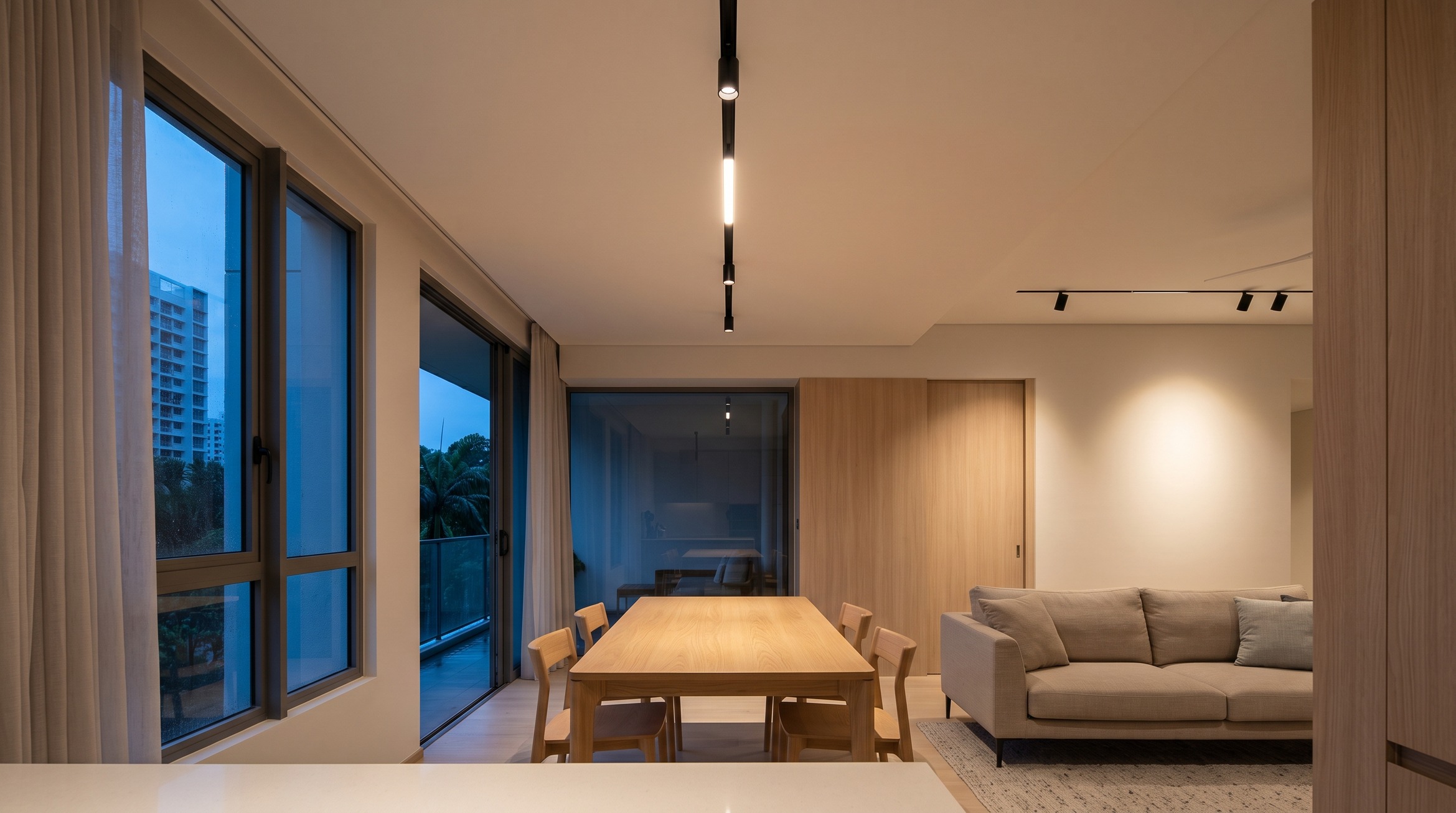
This magnetic track light guide breaks down how the system works and what to decide before anything gets installed.
Magnetic track lighting has become the default request in Singapore renovations over the past couple of years, and for good reason. You get one clean rail across the ceiling, and you move the lights along it whenever you want.
But it’s also where people spend more than they need to. The system uses specific low-voltage components that a standard track light doesn’t, and if you plan it after the false ceiling is up, your options narrow fast.
How Magnetic Track Lighting Actually Works
A standard track light runs at mains voltage, and each fitting clips and twists into the rail. Magnetic track works differently.
A driver converts mains power down to low-voltage DC — typically 48V — before it reaches the rail. The light modules then hold onto the rail magnetically and draw power through contact strips built into it. No clips, no twisting, no tools.
Two things follow from that, and they’re the real reasons to choose the system:
You can rearrange the lights whenever you like. Move a spot along the rail, swap a grille module for a linear one, add a head later. Nothing needs rewiring.
The rail stays visually quiet. Because the modules sit inside a slim aluminium channel rather than hanging off it, a magnetic run reads as a line in the ceiling rather than a row of fixtures.
The trade-off is that you’re buying a system, not a light. Rail, modules, driver and connectors are separate items, and they have to be specified together.
The Module Types and What Each One Does
This is where magnetic track earns its keep — you can mix module types along a single rail depending on what each part of the room needs.
Spot modules throw a narrow beam. Use them over a kitchen island, on artwork, or anywhere you want one thing picked out. The Magnetic Track Spot Light is a 10W adjustable head.
Grille modules recess the LED behind a honeycomb baffle, which cuts glare when you look up at it. The Adjustable Lego Grille tilts, and there’s a fixed version if you don’t need the aim to change. The Tiltable Grille is a 12W option with more adjustment range.
Linear modules give a wide diffused wash rather than a beam. The Linear Diffused module fills in general light, which stops a track run from looking like a row of spotlights with dark gaps between.
In practice, most living room runs mix all three: linear for ambient fill, grille for general task light, spot for anything you want highlighted.
Recessed vs Surface-Mounted Rail
This is the decision that has to happen before the ceiling goes up, because it can’t be changed afterwards.
Recessed Rail
The rail sits flush inside the false ceiling, so only a narrow slot is visible from below. It’s the cleaner look and the one most people picture when they ask for magnetic track. The recessed rail comes in various lengths.
The catch: you need a false ceiling deep enough to house the rail and the driver, and the opening has to be cut to the right width during carpentry. Deciding on this after the plasterboard is finished means hacking it open again.
Surface-Mounted Rail
The rail screws directly onto the ceiling. It sits proud rather than flush, which some people prefer as a deliberate architectural line.
This is the practical option for HDB flats without a false ceiling, for rental units, and for anyone who doesn’t want to lose ceiling height. It’s also far easier to add later.
Planning the Driver and Rail Length
No magnetic track light guide would be complete without addressing driver selection and rail sizing—two technical details that cause the most common installation headaches.
The driver has to handle the total load. Add up the wattage of every module you plan to put on the rail, then size the driver above that. Running a driver at its ceiling causes flickering and, at worst, tripping. Leave headroom, because people almost always add modules later.
Voltage drop matters over long runs. Modules at the far end of a very long rail can appear dimmer than those near the feed. For a typical HDB living room run this isn’t an issue, but long continuous runs may need a second feed point.
Where the driver goes also matters. Recessed installations usually need it concealed in the ceiling void with access for maintenance — worth agreeing with your contractor rather than discovering later that it’s sealed in.
Magnetic Track Light Guide: Planning Room by Room
Living rooms. The strongest case. One rail replaces several separate fittings, and you can re-aim everything when the furniture moves.
Kitchens and islands. Spot modules over a counter, linear fill along the rest. Useful because kitchen layouts change more than people expect.
Dining areas. Works alongside a pendant over the table rather than competing with it — grille modules for general light, spots on the serving area.
Where it’s usually overkill. Bedrooms and small study rooms rarely justify the system cost. A couple of well-placed downlights or a single ceiling light does the same job for less. Magnetic track pays off where you genuinely want flexibility, not simply because it looks current.
Common Questions About Magnetic Track Lighting
Is magnetic track more expensive than normal track lighting?
Yes, magnetic track lighting generally has a higher upfront cost than standard track lighting. Unlike standard track light system, magnetic track systems require separate 48V LED drivers, specialized aluminum magnetic track channels, and magnetic light modules.
Can I install magnetic track without a false ceiling?
Yes — surface-mounted rail screws directly to the ceiling. Only the recessed version needs a false ceiling.
Can I add more magnetic track lights to the track later?
Yes, you can easily add or relocate lights on a magnetic track at any time without tools or rewiring.
-
Driver Capacity: You can attach additional light modules as long as the total combined wattage does not exceed your 48V LED driver’s rated power.
-
Track Space: You must have sufficient physical rail length available to snap in the new light modules alongside your existing fittings.
Can magnetic track lighting be dimmed?
Yes, magnetic track lighting supports dimming, but it is controlled through Smart App systems or handheld RF remotes rather than traditional wall dimmer switches.
-
Smart & Remote Dimming: Most magnetic track systems in Singapore use built-in 48V smart receivers or smart modules, allowing you to adjust brightness and color temperature (CCT) via apps (like Tuya / Smart Life) or a wireless remote.
Still planning your layout after reading this magnetic track light guide? Aspire Lightings is a lighting shop in Singapore carrying the full magnetic track light system — rails, modules and drivers — at its Bendemeer Road showroom. Glare and beam spread are much easier to judge with the modules running in front of you than from a product listing.
Contact
Aspire Lightings Pte Ltd
994 Bendemeer Road, #01-05 B-Central, Singapore 339943
Phone: +65 6909 0528 | WhatsApp: +65 8685 8188
Website: aspirelights.com
Contact us