
Best Outdoor Lighting Ideas for Singapore Homes & Balconies (2026 Guide)
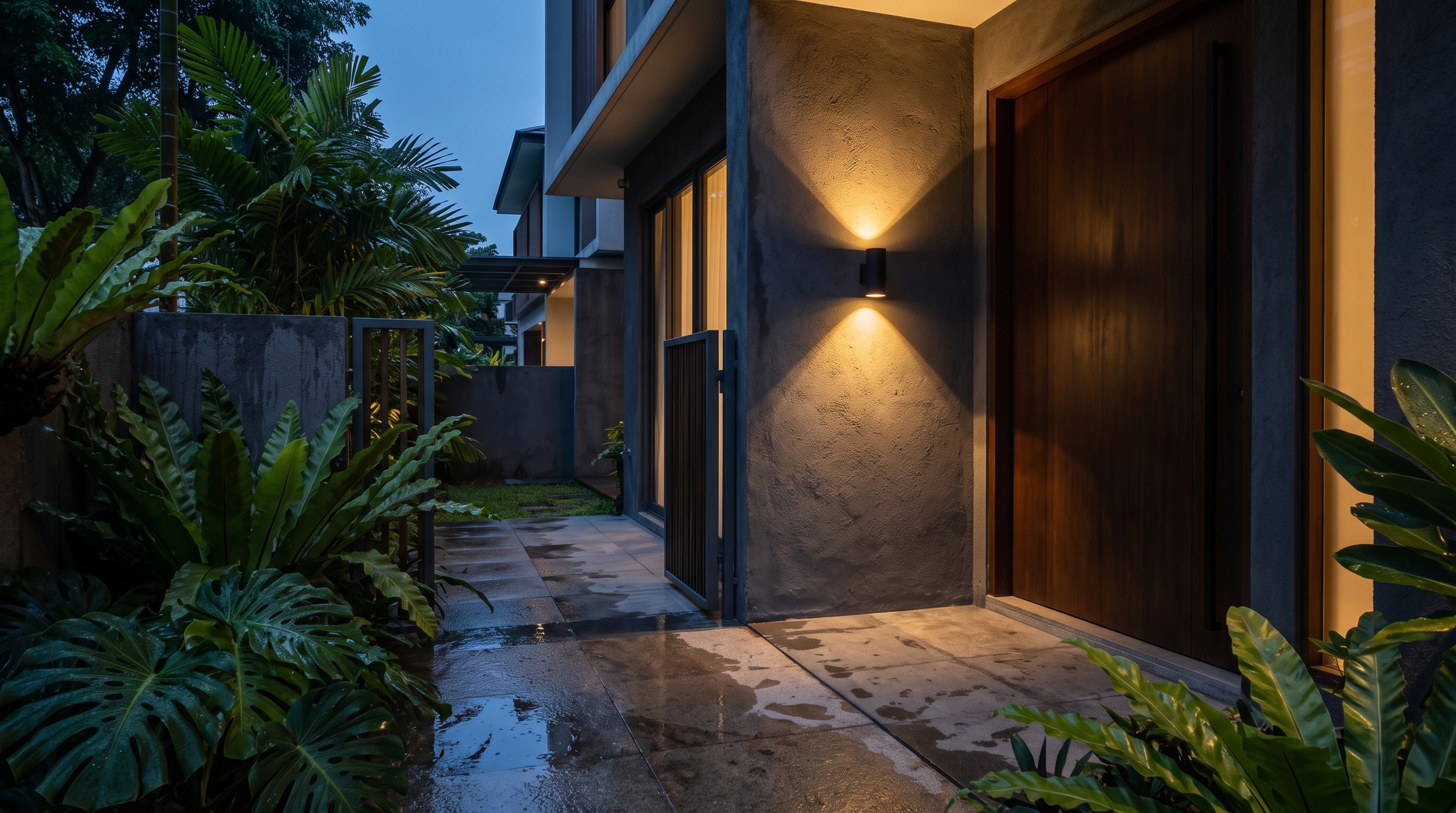
If you’ve had an outdoor light corrode, fog up or die within two years, it probably wasn’t a bad bulb. It was the wrong fitting for the spot.
Singapore is hard on outdoor lighting. It rains here on about 171 days a year, humidity averages 82% and hits 100% during a long downpour, and 2025 was the 7th wettest year since 1980. Any light outside is dealing with damp air constantly, direct water every other day, and heat in between.
That’s what decides whether it lasts. Not the brand, not the design.
Types of Outdoor Light Fixtures and Where Each One Works
Wall Lights — The Default for Entrances and Corridors
Most Singapore homes end up with wall-mounted lights. On a corridor, a gate pillar or beside a front door, there’s usually nowhere else to put anything.
Up-and-down beams aren’t just a style choice. A single downward beam drops a pool of light on the floor and leaves the wall above it dark, which looks harsh. Split the light in two directions and it washes the wall instead — and that bounced light does more for the space than the direct beam does.
The outdoor light range covers the main beam patterns. The Curva gives a soft up-and-down wash. The Round and Square give a tighter twin beam. The 3 Way and 4 Way throw light sideways too, so you cover more from one point.
Bulkheads — For Ceilings and Covered Walkways
Bulkheads sit flat against a ceiling or wall. They’re the right call for covered walkways, car porches and the underside of a corridor ceiling, where a wall light sticking out would just get in the way.
The Megaman rectangle and round bulkheads are the usual pick. Megaman is a well-known LED brand, and that matters more outdoors than indoors — on a cheap outdoor light, the driver usually gives out before anything else does.
Pathway Lights — To Mark a Route, Not Light an Area
These sit low along a walkway, driveway or garden path. You’re marking the edge of the route so nobody steps off it. You’re not trying to light the whole garden.
Most people buy too few and space them too far apart. That gives you bright pools with dark gaps in between. Closer spacing at lower brightness looks better almost every time.
Spotlights and Garden Uplighting
Spike lights push into soil or planter beds and point upward at a tree, shrub or feature wall. They have the hardest job of any light in the house — wet soil underneath, rain on top, no shelter at all.
If you’d rather mount at wall height than stake into a bed, the Twin Spotlight has two heads you can aim separately. Useful when you want to light a tree and a section of wall from the same spot.
One thing people get wrong here: beam angle matters more than brightness. Narrow beam for a slim tree, wider for a dense shrub. Go too wide and you end up lighting the wall behind the plant instead of the plant.
For landed homes, floodlights and bollards handle driveways, where you want broad even light rather than a feature.
IP Ratings Explained
Every proper outdoor light has an IP (Ingress Protection) rating, set under the international IEC 60529 standard. Two digits: the first is dust, the second is water. If something is sold as “outdoor” but doesn’t state an IP rating, treat it as an indoor light.
What IP44, IP65 and IP66 Mean in Practice
IP44 — Handles splashes, but isn’t dust-tight. Only for properly sheltered spots: a deep covered porch, or a recessed balcony that never gets direct rain.
IP65 — Dust-tight, and handles water jets from any direction. This is your minimum for anything actually exposed — open corridor walls, garden lights, anywhere with no overhang.
IP66 and up — Built for high-pressure water and temporary flooding. Worth it at ground level on driveways, near the sea, or where water collects after heavy rain.
Why a Higher Rating Isn’t Always the Better Buy
The IP rating only tells you about water and dust getting in. It says nothing about the housing, the driver or the finish — and on a cheap light, those fail first anyway.
A lamp under a deep overhang does fine at IP44, and the money saved is better spent on build quality than on a rating that spot doesn’t need. But anything on an open balcony or out in a garden should be IP65 or higher. No exceptions there.
Outdoor Light Placement Tips by Home Type
HDB Balconies and Corridors
Most are semi-sheltered, so IP44 is often enough if you’ve got a decent overhang.
The thing people miss is direction. Our heaviest rain comes between November and January, during the wet phase of the Northeast Monsoon — and monsoon rain is wind-driven. It comes in at an angle, and an overhang won’t stop it.
There’s also a west–east difference worth knowing. More rain falls on the western side of the island than the eastern, because of a rain shadow effect. So a west-facing balcony in Jurong takes more water than an east-facing one in Bedok, even with the same overhang.
If your balcony catches the weather, go IP65. And mount to your own wall or ceiling, not to the railings or the external facade.
Condo Patios and Ledges
Units vary a lot, so the easiest test is to watch your own space during a downpour before you buy anything. A corner that stays dry all year can take a lower-rated light. Anything near the open edge can’t.
Two smaller wall lights usually look better than one bright one, and light the space more evenly. If running a second wiring point isn’t practical, a 3 Way or 4 Way spreads light in several directions from the one position you’ve already got.
Landed Gardens and Driveways
This is the toughest case — rain, wet soil, humidity and direct sun all at once. IP65 throughout as your baseline, higher at ground level where water collects.
Layering matters most here. Wall lights at the entrance, pathway lights along the route, spotlights on the planting. Three softer lights look planned. One bright floodlight trying to cover everything just looks like a car park, and throws hard shadows behind everything it hits.
How to Choose the Right Outdoor Light for Your Home
Work through it in this order:
- Look at how exposed the spot really is — including which way the rain blows in.
- Set your minimum IP rating from that.
- Narrow down to lights that meet it.
- Then pick the one you like.
Doing it backwards — choosing the light first and hoping the rating works — is how people end up buying outdoor lighting twice.
If the work goes beyond swapping a bulb, it’s worth having it done by a professional electrician.
Common Questions About Outdoor Lighting in Singapore
Why did my last outdoor light stop working so quickly?
Usually the driver, not the LED. Humidity and constant heat cycling wear out cheap drivers faster than the seals fail, which is why two lights with the same IP rating can last very different lengths of time.
Warm white or cool white outdoors?
Warm white around 3000K suits entrances, gardens and anywhere you want the place to feel welcoming. Cooler white suits driveways and security lighting, where seeing clearly matters more than atmosphere.
Can I install an outdoor light myself?
Swapping like-for-like is straightforward enough. Adding a new point, running a new circuit or mounting onto an exterior wall should go to a professional electrician.
Aspire Lightings is a lighting shop in Singapore with a full outdoor range at its Bendemeer Road showroom, plus lighting installation — so the light, the wiring and the weatherproofing get sorted together instead of in separate steps.
Contact
Aspire Lightings Pte Ltd
994 Bendemeer Road, #01-05 B-Central, Singapore 339943
Phone: +65 6909 0528 | WhatsApp: +65 8685 8188
Website: aspirelights.com
Contact us